
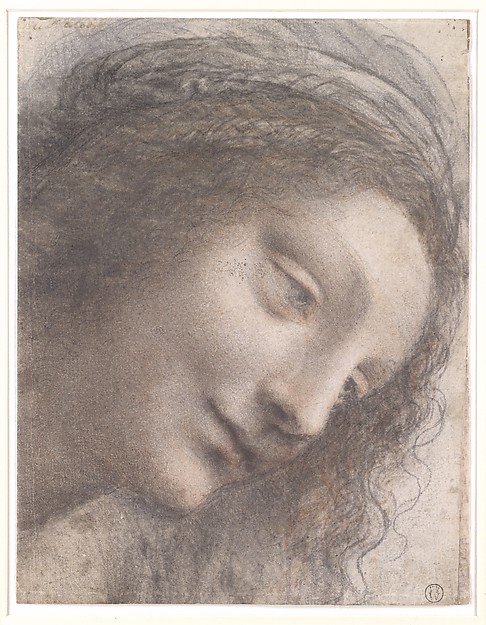
A boundary can be gradual.
Sfumato is the soft, atmospheric treatment of contours through gradual changes in tone. A form can seem to emerge from shadow instead of being enclosed by a firm outline. The National Gallery connects the term with the smoky quality of those transitions.
Source: National Gallery: Sfumato.
Try looking for the transition rather than the line. Where does the cheek turn away from the light? How much of the edge can you identify without drawing a contour around it?
An original teaching comparison
Two ways to describe a form.
These simple illustrations hold the shape and background steady while changing the treatment of its edge. They are a way to notice the effect, not a reconstruction of Leonardo’s materials or technique.
Compare the contour and the transition. Both are original teaching illustrations of the same simple form.
Illustrations by DaVinci Entertainment Holdings. Neither image is a historical artwork. No blur or alteration has been applied to the Leonardo drawing.
Now return to Leonardo’s drawing.
The Met identifies this sheet as a study connected with the Virgin in Leonardo’s Virgin and Child with Saint Anne. Its catalog describes red and black chalks and the subtle, blended modeling of the face.
Follow the shadow around the eye and the turn of the cheek. Then look at the hair, where more definite marks remain. A softly treated face can exist within a drawing that also contains clear, purposeful lines.
Object and curatorial discussion: The Metropolitan Museum of Art, object 337496.
An effect, not one universal recipe.
It is tempting to reduce sfumato to a simple formula. The physical evidence is more specific. In its study of the London Virgin of the Rocks, the National Gallery describes careful thinning and blending in the examined flesh passages, rather than confirming the same elaborate stack of translucent layers in every example.
That distinction matters: a modern visual comparison can illustrate a principle without reproducing the way a particular painting was made.
A closer distinction: outline, modeling and atmosphere
An outline marks a boundary. Tonal modeling describes how a surface turns toward or away from light. Atmospheric effects can make a distant or shadowed form less definite. These ideas may work together, but treating an entire image with a uniform blur does not explain them.
Conservation evidence: Keith, Roy, Morrison & Schade, 2011.
Continue the investigation
Sources & image.
- National Gallery: SfumatoThe term and its visual character.
- The Met: The Head of the VirginAttribution, materials, context and image credit.
- Virgin of the Rocks: Treatment, Technique and DisplayEvidence from close examination of the painting.
Prepared for The Leonardo Workshop. First edition, November 2026. How this Workshop handles evidence and corrections.