
Lift is one part of flight.
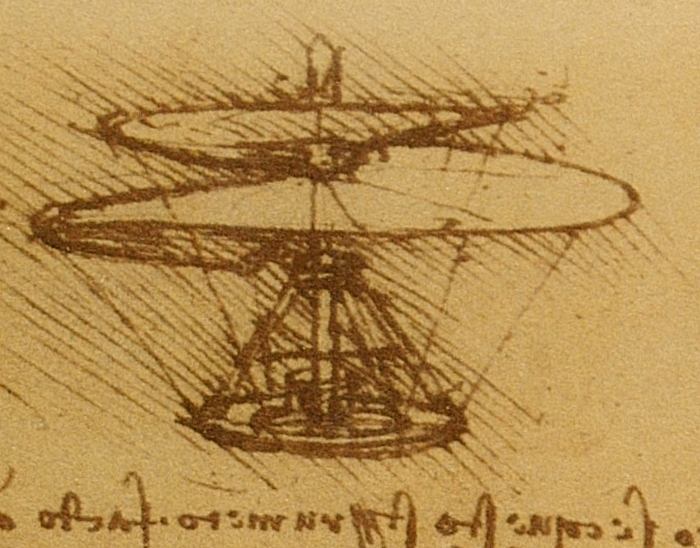
The drawing proposes rotary flight. It does not establish that Leonardo built or flew the machine. Modern research on a modified screw rotor answers a narrower question about that rotor’s behavior—not the viability of the complete human-powered design.
To assess the idea, separate the turning surface from the vehicle carrying it. A surface may generate an upward force while the whole machine remains too heavy, underpowered or difficult to control.
Historical design: Museo Leonardiano. Modern research: Prakhar, Seo & Mittal, 2025 preprint.
Begin with the sheet.
The Museo Leonardiano identifies the source as Manuscript B, folio 83 verso. Its reconstruction uses a spiral canvas around a vertical mast. The museum explains Leonardo’s analogy: a rapidly turning screw might rise through the air as a screw advances through a material.
That historical explanation is worth understanding on its own terms. Modern engineering asks how moving air produces forces, how much power is needed and how the vehicle behaves in response.
The museum’s exhibited model was made in 1938. It is a later interpretation of the drawing, not an object made by Leonardo. Read the model record.
Explore the idea
Three questions to follow.
Use the simple diagram to separate the surface, the source of motion and the behavior of the complete machine.
What force can the surface produce?
As a surface moves through air, it can redirect that air and experience a force. The shape, size, angle and speed matter. The spiral shape alone does not tell us how much useful upward force the machine would generate.
Where does the energy come from?
Turning the rotor against air resistance takes power. The historical human-powered interpretation introduces a practical limit: the people driving it must also be carried, along with the structure and mechanism.
What keeps the vehicle under control?
The structure must support the load and maintain the rotor’s shape. The drive also creates a reaction torque. Lift, balance, stability and control need to be considered together; a rotor result does not settle them all.
Original, simplified teaching diagram. It is not a manuscript facsimile, a tested reconstruction or a flight simulation. Highlights identify components; they do not show measured forces.
A little more engineering: force, power and torque
For steady hovering, upward thrust would need to balance the weight of the complete vehicle. Mechanical power is torque multiplied by angular speed. The torque used to turn a rotor has a reaction on the rest of the system. Meeting a thrust requirement alone therefore says little about whether an aircraft can remain stable or be controlled.
No performance values are calculated here. A numerical prediction would require a specified geometry, mass, rotation rate, material behavior, aerodynamic model and validation against measurements.
Keep the kinds of evidence separate.
- The surviving designThe drawing is evidence of an idea Leonardo investigated. It is not, by itself, a flight record.
- The museum reconstructionA later model makes the arrangement easier to understand. Its existence does not demonstrate successful historical flight.
- The modern rotor studyA 2025 preprint uses numerical simulations of a modernized screw rotor and compares it with a two-bladed rotor under specified conditions. Those results concern the modeled designs, not Leonardo’s complete machine.
- The open engineering questionMaterials, total mass, available power, structural behavior and control would all need to be specified and tested before making a claim about a complete flying vehicle.
Modern-study scope: Aerodynamics and Aeroacoustics of da Vinci’s Aerial Screw. The publication is identified here as a preprint; no independent validation is claimed.
Continue the investigation
Sources & drawing.
- Museo Leonardiano: Aerial screwManuscript reference, historical explanation and model provenance.
- e-Leo: Manuscript B, folio 83vThe digital manuscript reference linked by the museum.
- Prakhar, Seo & Mittal: Modernized screw-rotor studyA numerical study with its own geometry and conditions.
- Wikimedia Commons: Drawing reproductionSource image, crop history and public-domain statement.
Prepared for The Leonardo Workshop. First edition, November 2026. This feature presents an explanation, not instructions for building an aircraft. Editorial standards.